
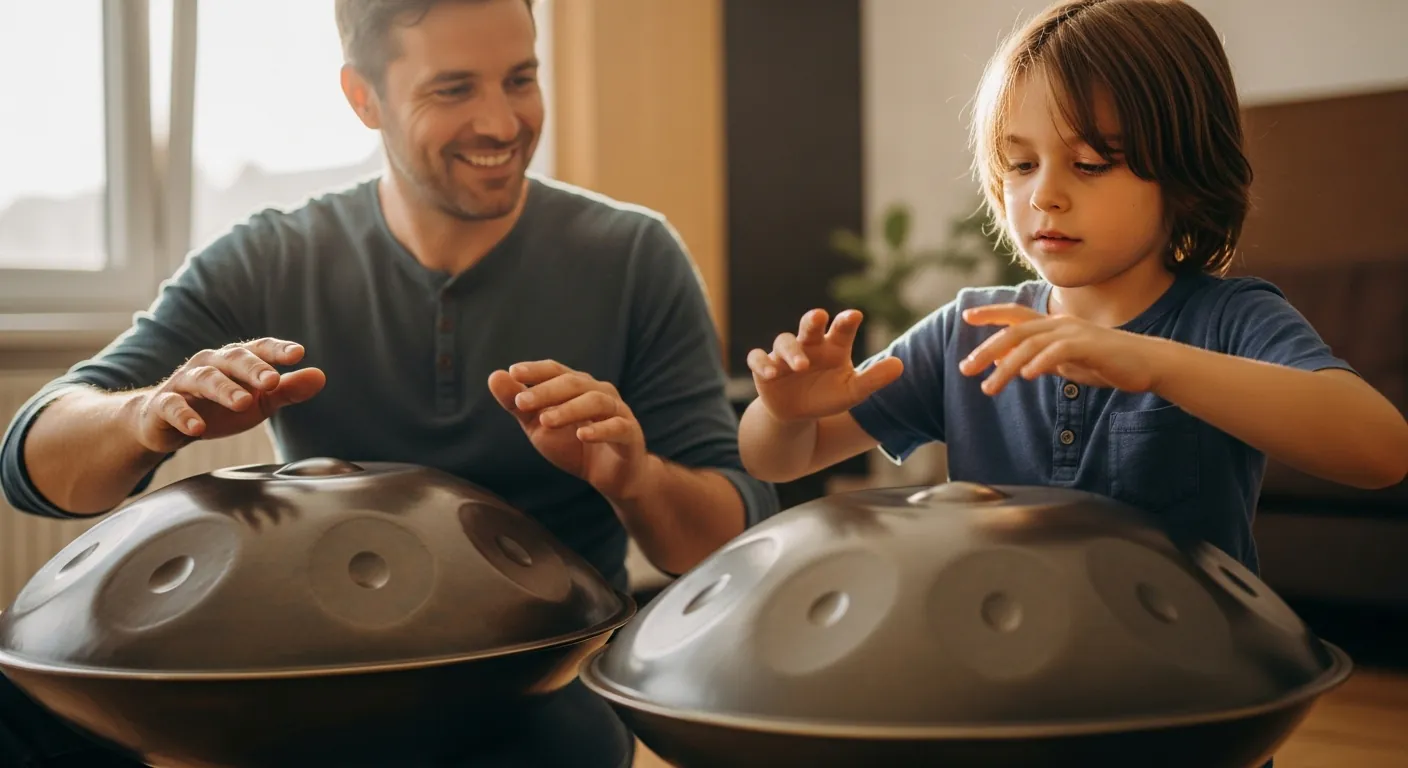
Handpan It's a unique instrument that captivates with its sound and improvisational possibilities. I'm increasingly asked about handpan duets—both for concerts and home sessions with another person. The most common questions are: Is it better to play two handpans in the same scale or different ones? Can instruments tuned to 432 Hz be combined? 440 Hz? I answer below.
Handpans scales-together or separately?
Choosing the right scale for a second handpan is one of the most common questions when ordering another instrument for a duo. I help determine this with every order. Below are the two options I encounter most frequently.
The same scale-simplicity and harmony
Playing two knobs on the same scale is the easiest and most intuitive way to collaborate on music. The sounds of both instruments will always be in harmony with each other, which greatly facilitates improvisation and allows you to focus on a relaxed game with music. This solution is ideal for beginners and for those who appreciate clarity and consistency of sound.
Different Scales-creativity and challenge
Combining two hands with different scales opens up completely new possibilities. You can get a wider range of sounds, build more complex harmonies, and experiment with unusual connections. However, this requires more musicality and awareness — not every combination of scales will sound good. It is best to choose related scales that have sounds in common (for example, related scales). D Kurd and D Amara), or parallel scales (major and minor scales of the same key). The bigger the difference, the harder it is to avoid dissonance.
Extended Connections
More advanced players combine distant scales to achieve a nearly complete chromatic range. Such combinations produce colorful, unconventional improvisations, but require a keen ear—otherwise, it's easy to miss the mark. If you're just starting out in a duet, leave this variation for later and stick to related scales.
432 Hz and 440 Hz settings-can I combine them?
The scale is one thing, but the second requirement for a harmonious duet is a common frequency. Handpans tuned to different standards simply won't play well together—no matter how carefully you choose the scales. Before ordering a second instrument, check the tuning of the handpan you already own.
440 Hz-world standard
Most instruments in the world, including handpans, are tuned to a frequency of 440 Hz. This standard ensures compatibility with other instruments and allows for playing together without intonation issues.
432 Hz-An alternative for seekers
Customization up to 432 Hz, it is gaining popularity in relaxing and meditative music. The sound is slightly lower, warmer and, according to some, more "natural". However, this is not a standard in Western music.
Can I play together at 432 Hz and 440 Hz?
Unfortunately, this is not a good idea. The difference of 8 Hz makes the instruments incompatible. There are unpleasant rumblings, sounds "diverge", and all this sounds unclean. So if you plan to play as a duo, both handpans should be tuned to the same frequency — either 432 Hz or 440 Hz.
Summary-how to play harmoniously on two handles?
- For beginners: Choose two hands in the same or very similar scale and in the same outfit. This is a guarantee of harmony and ease of play.
- For advanced users: Experiment with different but related scales. However, don't forget that both instruments are tuned to the same frequency.
- Avoid connecting 432 Hz and 440 Hz - this leads to dissonance and unpleasant acoustic effects.
Handpan is an intuitive tool that gives you a huge amount of freedom and fun to create music. Playing together is not just about technique, but, above all, listening to each other and being open to experimentation. By following a few simple rules, you can enjoy the beauty of harmony and discover new musical worlds!
Are you planning to play in a duo and are looking for a second handpan to match your instrument? Write — I will help you choose the scale and tuning so that both instruments really get along.
Frequently asked questions
They don't have to. It's the scale and tuning (432 or 440 Hz) that matter, not the manufacturer. If you're choosing a second handpan for an instrument you already own, let me know its scale and tuning—I'll help you choose a matching one.
The safest choice is D Amara – it's a related scale, with some common notes, so the two instruments naturally complement each other rather than getting in each other's way.
Yes. Tell us what scale and tuning your current instrument has, and together we'll determine which second scale will sound best with it.

I run the Miłość i Spokój brand and personally test every instrument before shipping—playing it, checking its tuning, and listening. I work with handpan as a musician, a sound healing practitioner, and someone who simply can't stop playing.
One response to “Jak grać na dwóch handpanach? Skale i strojenie w praktyce”
Great explanation on combining scales and frequencies in handpan playing