
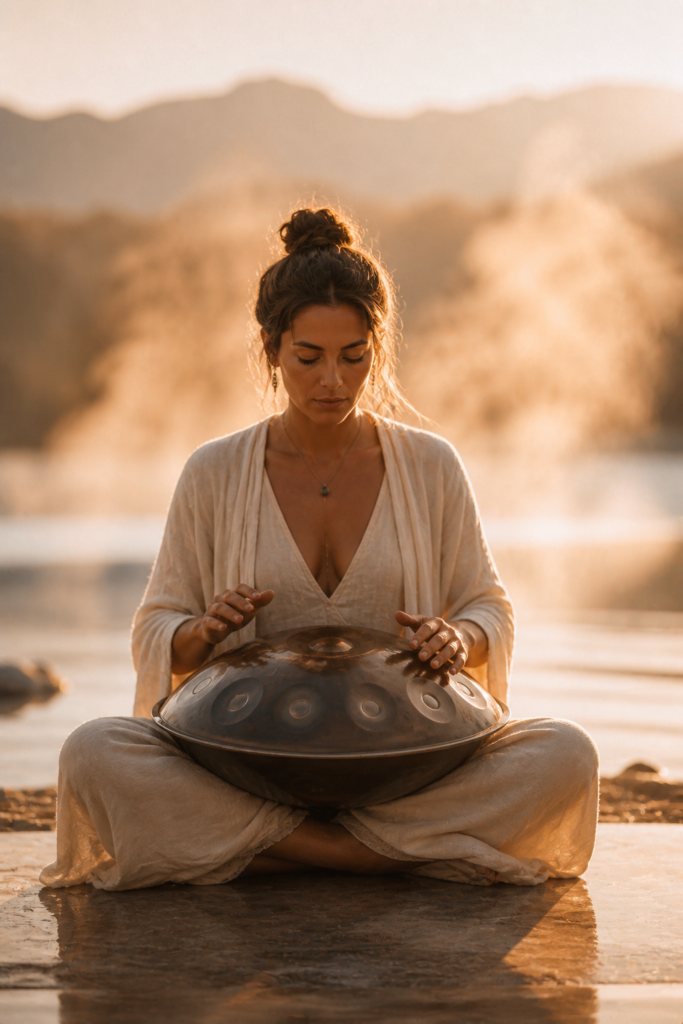
I know this from personal experience. I sit down with a handpan, hit the first square—and within a minute, I stop thinking about what just happened. The sound lingers for a few seconds before fading away completely. In that space between one hit and the next, something happens that's hard to describe in words.
Peace isn't silence. It's the ability to be with yourself even when things are noisy.
What is peace—and why is it so difficult to achieve?
We talk about peace as if it were a state you could flip a switch on. But it works completely differently. It doesn't come through willpower. It comes through the body—through breath, through sound, through rhythm.
On a physical level, peace means relaxed muscles, slowed breathing, and the nervous system in recovery mode. On a mental level, it's the ability to observe one's own thoughts without engaging in arguments with them. On a spiritual level, which interests many of my clients, it's the feeling of being in the right place.
None of these levels work in isolation. Therefore, practices that address all three simultaneously—such as handpan playing, sound meditation, or sound healing—produce effects that breathing training or sitting in silence alone typically do not.
Why handpan works for peace - specifically
When I play, I don't have a free hand to scroll through my phone. I don't have a free mind to plan tomorrow. The instrument demands presence. And that's precisely its greatest therapeutic value—not magic, not metaphysics, just the simple mechanics of attention.
But there's something else, too. The sound of a handpan—especially in the Kurd or Pygmy scale—has a natural melancholy and spaciousness that makes the body slow down on its own. I hear this from people who buy instruments from me: "I fell into a flow for a few hours," "I fell asleep playing myself for the first time in months.".
This is no accident. It's physics and acoustics at the service of the nervous system.
432 Hz vs 440 Hz tuning – what to choose for relaxation?
I'm often asked this question when choosing an instrument. The short answer is: both tunings work; the difference is subtle but real.
432 Hz sounds a bit warmer and more "round" - many meditation and sound healing practitioners choose this tuning,, because it is easier for them to calm down with it. 440 Hz is the standard for Western music—the sounds are clearer and resonate better with other instruments. If you're playing alone, for yourself, or for meditation, 432 Hz is a common choice. If you plan to play with other musicians, 440 Hz will be more comfortable.
I have both tunings available. When ordering, you can also choose a scale for your practice—I'll help you figure it out.
→ Check out the handpan scales on offer
How to practice calmness with a handpan - without exaggeration and without a course
You don't have to know how to play. Seriously. Most people who buy from me handpan, has no musical training. And that's one of the things I value most about this instrument—it produces an effect from the very first touch.
Some things that really work:
Five minutes in the morning before you reach for your phone. Sit down with your instrument. Don't play any melody—just strike individual squares slowly. Listen to the sound decay. Repeat. That's enough.
Improvisation as moving meditation. Instead of sitting still and fighting your thoughts, give your body something to do. Hands on the instrument, attention on the sound—your thoughts will calm themselves.
Game after a difficult day. Several of my clients say that handpan has replaced alcohol as a way for them to "come down" after work. I say this without irony—it really does work differently and better.
Sound healing in a group. If you lead yoga or meditation classes, or work therapeutically with groups, the handpan as a work tool is something worth discussing separately. Please contact me.
Which instruments do I recommend for practicing peace?
The Kurd, Pygmy, and Amara scales are particularly well-suited for meditation and daily relaxation practice. They have a natural depth to them and don't "rush"—they allow you to breathe.
If you're just starting out and don't know where to begin, the Professional Series is a solid choice starting at 5,000 PLN. I personally test each instrument before shipping—playing it, checking the tuning, and checking the sustain.
If you want something more—a deeper sound, more overtones, a warmer tone that literally resonates in your chest—the Mystic Series is the category for someone who takes their instrument seriously.
→ See sample projects in my online store
FAQ - The questions I get most often
No. The instrument is intuitive. The first "flow" usually happens during the first session.
I most often recommend Kurd or Pygmy—both are calming and work well for calming practice. If you're unsure which to choose, please let me know—I'd be happy to help you choose a scale that's right for your practice.
Yes, it's used by therapists, yoga teachers, and circle leaders. If you're involved in this type of work, we can discuss selecting an instrument for your specific needs.
You'll find videos of various scales and tunings on my YouTube channel. Or you can just message me—I'll describe the sound so you can feel the difference.
At the end
Peace isn't a state you achieve once and forget about it. It's a practice. Daily, sometimes unsuccessful, often surprising.
Handpan isn't a magic shortcut. It's a tool that—if you use it regularly—does its job. Quietly, slowly, and quite effectively.
If you have questions about the instrument or would like to discuss what would suit your practice - text me. I play alone, I know what I'm talking about.

I run the Miłość i Spokój brand and personally test every instrument before shipping—playing it, checking its tuning, and listening. I work with handpan as a musician, a sound healing practitioner, and someone who simply can't stop playing.