

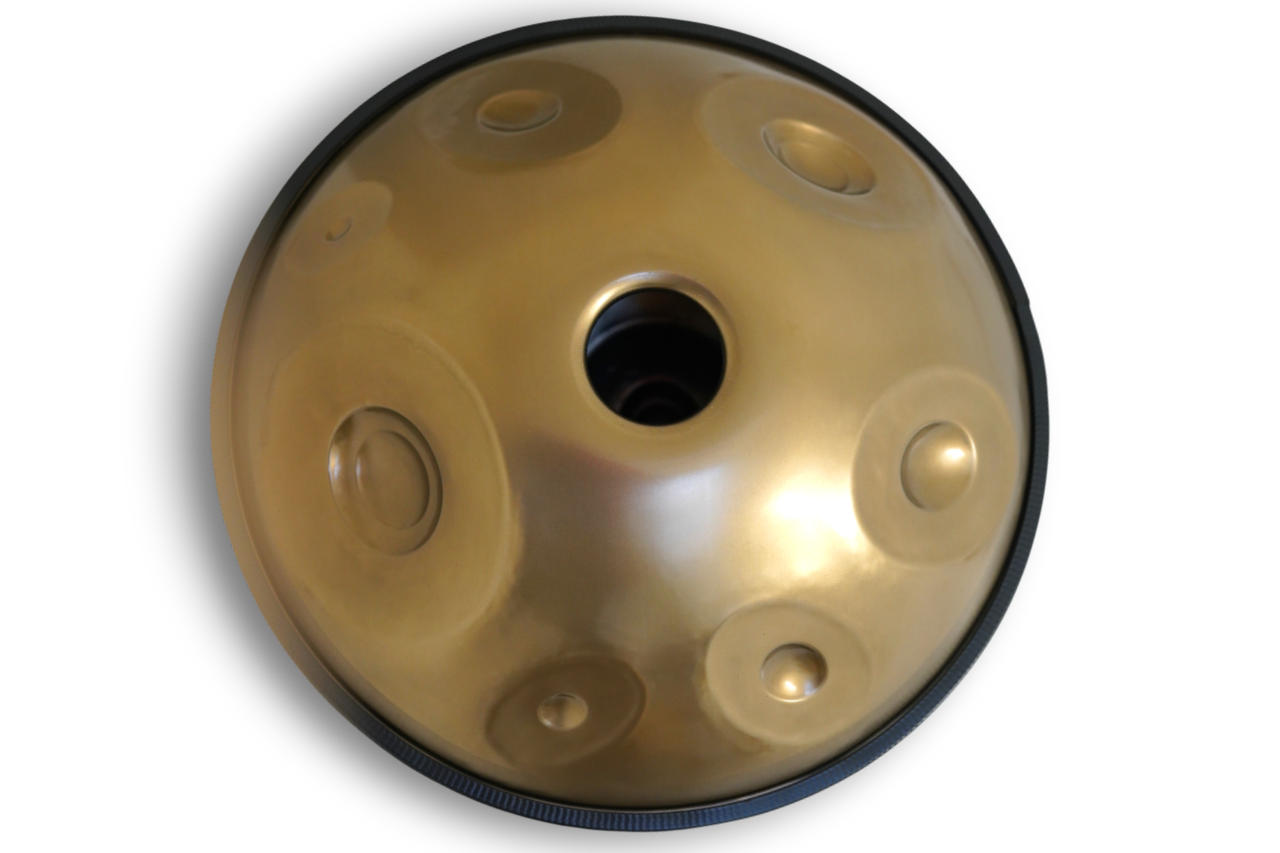
My own handpan—the F#3 low Pygmy—is tuned to 432 Hz. This is a conscious choice, not a coincidence or fashion. In this article, I explain the difference between the two tunings, tell you what I hear, and help you decide—before you order a 432 Hz or 440 Hz handpan.
Where do these two frequencies come from?
Every note vibrates. The number of vibrations per second is called frequency—measured in hertz (Hz). In music, the note A, the reference point for all tuning, can vibrate at different speeds.
440 Hz has been the global standard since the mid-20th century. Orchestras, guitars, pianos—almost every instrument in Western music.
432 Hz is tuning, 8 Hz lower. A subtle change: no note changes name, no scale loses character. Handpan D Kurd 432 Hz is still the same Kurd—the same depth, the same melancholy. Something different changes. Something more difficult to measure than to describe.
What do you hear at 432 Hz — and what at 440 Hz?
The 432 Hz handpan sounds slightly warmer and darker. The sustain—that note that decays a few seconds after being struck and fills the room—seems to decay more gently. Many players describe it as a more rooted, earthy sound.
The 440 Hz handpan sounds brighter and clearer. The sound is precise and focused. It cuts through effortlessly in spaces with other instruments.
It's not a difference between beautiful and ugly. Both tunings can be delightful. It all depends on how and with whom you play.
My handpan is in 432 Hz
I play for myself. During meditation, after a busy day, when I want to sit in silence and let the sound guide my thoughts.
In this context, 432 Hz sits differently. There's something about this tuning that doesn't demand attention—the sound doesn't push forward. It decays and then lets go.
If I were regularly playing with other musicians, I'd choose 440 Hz. This is a practical decision, not an aesthetic one. A 432 Hz handpan paired with a 440 Hz guitar sounds out of tune—because it's out of tune relative to the guitar.




When to choose a 432 Hz handpan?
You play alone and for your own practice. Meditation, yoga, or winding down after work—432 Hz is a natural fit. The sound of this tuning promotes focus and introspection. It fills small, acoustic spaces with a soft, non-aggressive sound.
You conduct individual sound healing sessions. Many sound therapists use 432 Hz as their primary instrument for working with participants. Its warmer, slightly deeper sound promotes a state of calm and relaxation.
You are buying one instrument to play solo. If you don't plan on playing with other musicians, you're free to choose. 432 Hz is a choice that many people describe as more "my own.".
Both tunings are available in every instrument in the Miłość i Spokój range - both Professional Series What Mystical Series. We determine them when ordering.
When to choose a 440 Hz handpan?
You play or plan to play with other musicians. This is the only situation where tuning becomes a technical matter, not an aesthetic one. Jams, workshops, playing together—440 Hz is the only sensible choice here.
You learn from online tutorials. Most YouTube recordings are of 440 Hz instruments. This consistency is important when practicing by ear.
You're at the beginning and you don't know how you're going to play yet. 440 Hz leaves more options. You can play alone, but you also have the option to play with others.
Can you play 432Hz and 440Hz handpans together?
No – and this is important information for therapists and teachers working with several instruments.
Two handpans in different tunings played simultaneously create a beating effect—a rippling sound that is physically audible and acoustically unpleasant. If you plan to buy a second instrument or conduct group workshops, both should be in identical tuning.
432 Hz in meditation and sound healing
In sound therapy circles, 432 Hz holds a special place. It's referred to as a tuning closer to nature. Science hasn't definitively settled this issue—and doesn't pretend to have. But from what I hear from players I've spoken with, experience suggests otherwise.
One thing is certain: sound has a physical effect on us. Tempo, dynamics, depth of tone—all of these influence the nervous system, breathing, and state of mind. The handpan itself—regardless of tuning—is one of the few instruments whose sound almost instantly slows down thought.
432 Hz adds something of its own. Not cosmic. Its own—warm, intimate. Many players describe it as a feeling of the sound resonating within rather than floating above it.
Subjective? Yes. Does that make it any less true? Absolutely not.
Recommended products

Handpan Celtic Minor (E Amara) 13 Premium Stainless Steel
9900,00 zlotyHandpan D Kurd 10 Premium Stainless Steel (Free Cover)
6100,00 zlotyHandpan F3 Pygmy 9 Premium Stainless Steel
6000,00 zlotyHandpan E Amara 20 (13+7) - Premium Stainless Steel
12900,00 zloty


One rule at the end
If you're playing alone, consider 432 Hz. If you're playing with others, choose 440 Hz. If you're not sure yet, 440 Hz leaves more doors open.
The rest is up to you. Listen to the recordings on YouTube channel @miloscispokoj — there you can hear both tunings in practice and see which one suits you better.
If you have any doubts before ordering - Write. I'll help you choose the right instrument for your practice. I personally test each handpan before shipping, regardless of the tuning chosen.
Want to start by choosing a scale? Check it out. a guide to handpan scales — because tuning is only the second step, the scale is the first.
FAQ - Frequently asked questions about 432 Hz and 440 Hz handpan
The character of the scale remains the same. Handpan D Kurd 432 Hz is still the same minor scale with the same melancholy and interval structure. Only the absolute pitch changes by a few Hz. Kurd is Kurd in both tunings.
Many practitioners and therapists believe this is because of its warmer, deeper sound. But a 440 Hz handpan is equally effective in inducing a meditative state. The scale, tempo, and intention are more important than the 8 Hz difference.
It's possible, but it requires the work of an experienced tuner and involves costs and risks. It's definitely better to decide before ordering.
No. Two instruments In different tunings, played simultaneously, they create a beating effect—an unpleasant acoustic undulation. Both instruments in a duo or group must be in the same tuning.
Yes - tuning is included with every order, both in the Professional and Mystic Series. Details in FAQ or by contact page.
Scale is a separate topic—and more important than tuning for your first instrument. Check it out. a guide to handpan scales, which will help you choose the right sound for your practice.
On the channel YouTube @miloscispokoj you'll find recordings of various instruments - you can hear the sound character in practice before you decide.
Have you chosen your tuning yet? Order your handpan in 432 Hz or 440 Hz — handpan shop Miłość i Spokój offers both tunings on every custom-made instrument.
Piotr Kaczorowski — Miłość i Spokój
I run the Miłość i Spokój brand and personally test every instrument before shipping—playing it, checking its tuning, and listening. I work with handpan as a musician, a sound healing practitioner, and someone who simply can't stop playing.

I run the Miłość i Spokój brand and personally test every instrument before shipping—playing it, checking its tuning, and listening. I work with handpan as a musician, a sound healing practitioner, and someone who simply can't stop playing.