
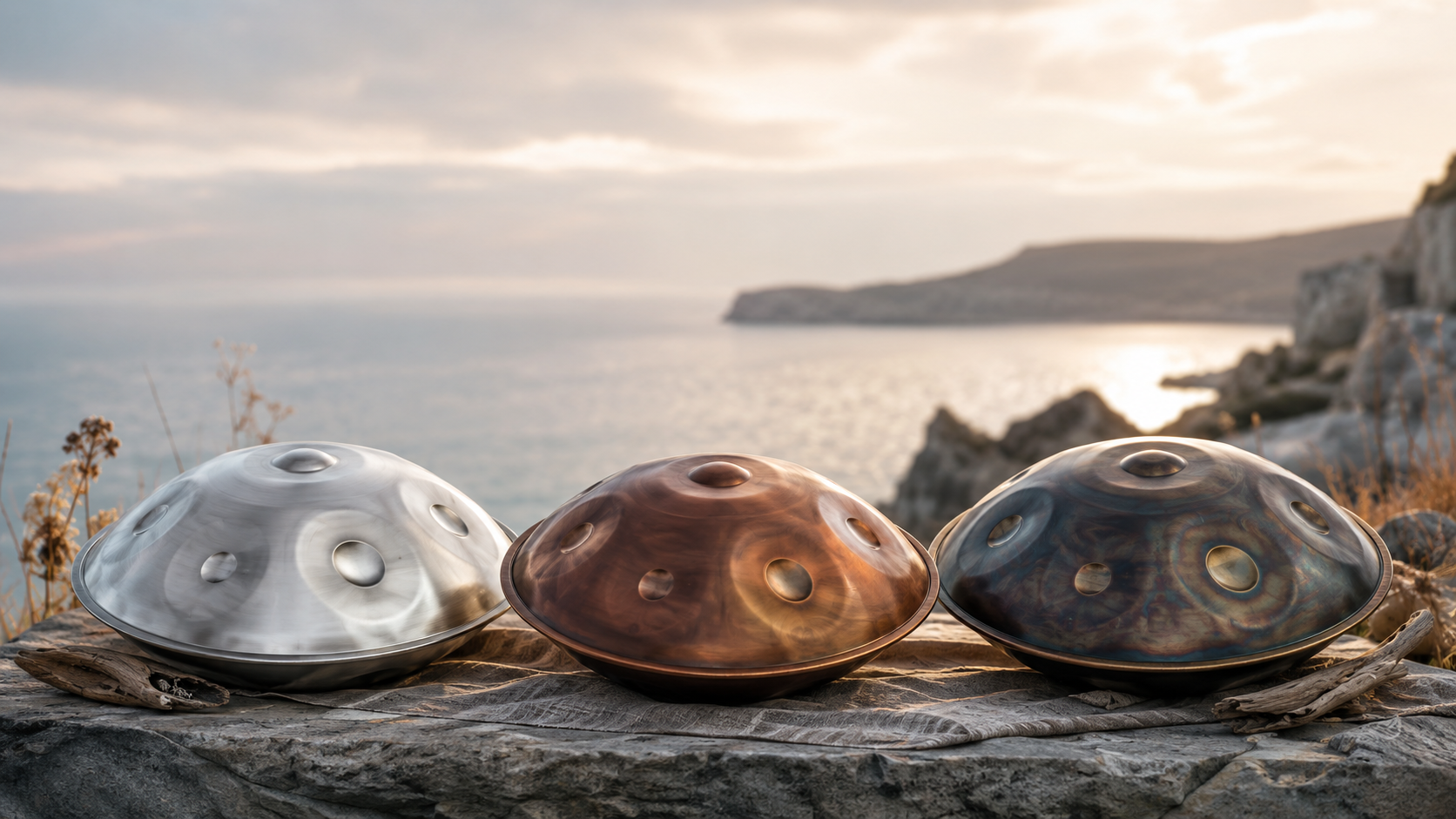
The type of steel is one of the key factors influencing a handpan's character: length and sustain, tone, response of the sound fields to touch, and maintenance requirements. However, this doesn't mean that one material is best for everyone. The choice should primarily depend on how you want to play and the sound you're looking for.
A long sustain promotes calm, melodic playing and the creation of spacious improvisations. However, sustain alone doesn't tell the whole story—it can be softer and more spacious or clearer and more direct. The instrument's resistance to moisture and the frequency of its maintenance also play a role.
My offer includes handpans made of two types of stainless steel: standard stainless steel in the Professional Series and stainless steel, which I refer to as Premium in my offer, in the Mystic Series.
1. Premium stainless steel – warm sound and spacious sustain
Premium Stainless Steel This is the name used in my offer for the stainless steel used in the production of Mystic Series handpans. It is not an official designation of the steel grade nor a commonly used name for a specific alloy.
Combined with appropriate construction and tuning, this material produces a warm, full sound, high responsiveness, and a long, spacious sustain. The instrument's final character is also influenced by the thickness of the sheet metal, the processing of the material, the arrangement of the sound fields, and the skill of the tuner.
Handpans are made of this material Mystical Series, created for people looking for a warm, full tone, high responsiveness and a spacious character of the instrument.
Premium Stainless Steel Handpan – most important advantages:
- Long, spacious sustain – sounds remain audible for a long time and create a soft, spatial background for subsequent notes.
- Warm and full tone – the sound is soft, deep and enveloping.
- High responsiveness – the sound fields respond well to a light touch, so a pure tone can be obtained without using much force.
- High corrosion resistance – a properly cared for instrument tolerates periodic contact with moisture well and does not require as frequent protection as a nitrided steel handpan.
- Good possibilities for complex configurations – in models with a larger number of notes, this material allows for long sustain, full tone and good balance between sound fields.
This material works particularly well in more complex Mystic Series configurations, as it allows for a warm tone, a spacious sound character and high responsiveness.
2. Standard stainless steel – a universal and proven choice
Standard stainless steel is now widely used for handpans. It combines long sustain, good corrosion resistance, and easy touch response. This makes it a suitable choice for both a first instrument and a handpan for experienced players.
Instruments belonging to this group are made from this material. Professional Series.
Stainless steel handpan – most important advantages:
- Long, clear sustain – the sustain may be similar in length to the Premium Mystic Series models, but has a more direct character.
- Good corrosion resistance – stainless steel is easier to maintain on a daily basis than nitrided steel and tolerates periodic contact with moisture well.
- Easy response to touch – it does not require much force to produce a clear sound, which makes it easier to learn the correct technique.
- Universal character – the instrument allows you to play both calm melodies and moderately fast rhythmic sequences.
- Good value for money – The Professional Series allows you to choose a hand-tuned instrument with a universal sound at a more affordable price.
Standard stainless steel has a brighter, clearer tone and a more direct resonance. The sustain is still long and can be similar to the Mystic Series, but the individual notes have a more distinct definition. This makes the instrument suitable for both melodic playing and for combining melody with rhythm.
The Professional Series and Mystical Series cater to different sonic preferences. The former offers greater clarity and versatility, while the latter offers a warmer and more spacious tone.
3. Nitrided steel – shorter sustain and rhythmic precision
Nitrided steel was one of the primary materials used in handpan production for many years and still has many supporters. Its sound is typically more focused and percussive, and the notes decay more quickly than those of stainless steel instruments.
This makes nitrided steel well suited to dynamic players who want to clearly separate notes, rhythmic beats, and percussion sounds.
The most important features of nitrided steel:
- Focused, rhythmic character – shorter sustain reduces overlapping sounds when playing quickly.
- Clear articulation – it is easier to clearly separate the melody from the rhythmic and percussion elements.
- Hardened surface layer – the nitriding process increases the hardness of the steel surface, which can improve its resistance to minor mechanical damage.
- More frequent care – compared to stainless steel, the surface requires more regular cleaning, drying and protection against moisture.
Does the type of steel affect the weight of the handpan?
Yes. Premium stainless steel handpans are typically lighter than comparable instruments made from standard stainless steel. For two identical models, such as the D Kurd 10, the difference can be approximately 1–1.5 kg.
The final weight is also influenced by the instrument's diameter, the number of notes, and the design of both domes, so it is best to compare models with the same scale and configuration.
Does temperature affect the handpan's tuning?
Any handpan, regardless of material, should be protected from excessive heat. Leaving the instrument in direct sunlight or in a hot car can temporarily affect its pitch.
If the handpan becomes very hot, it's best to move it to a shaded area and allow it to gradually return to ambient temperature. Avoid cooling the instrument rapidly or playing vigorously immediately after removing it from a hot car.
Comparison of materials used in the production of handpans
| Material | Nature of sound | Sustain | Corrosion resistance | Conservation | Works best in… |
|---|---|---|---|---|---|
| Premium stainless steel | Warm, full and spacious | Long, soft and spacious | High | Relatively easy | Calm improvisation, relaxation and melodic play |
| Standard stainless steel | Clear, bright and direct | Long and clearly defined | High | Relatively easy | Learning, improvising and combining melody with rhythm |
| Nitrided steel | Focused and more percussive | In short | Lower | More demanding | Fast, dynamic and rhythmic gameplay |
Which handpan material should I choose?
Mystic Series Premium Stainless Steel It's the perfect choice if you're looking for a warm, full tone, high responsiveness, and a long, spacious sustain. Instruments in this series are tuned by makers with extensive experience working with this material and more complex setups. This helps maintain good balance between notes, purity of sound, and a consistent character throughout the instrument.
Standard Professional Series stainless steel also offers long sustain, easy touch response, and good corrosion resistance. Its sound is clearer and more direct, making it a versatile choice for both first handpan, as well as for those who combine melodic playing with rhythm. This is a full-fledged, hand-tuned instrument at a more affordable price.
Nitrided steel It may be better suited to those who prefer fast, dynamic, and clearly rhythmic playing. Its shorter sustain reduces overlapping of notes, but the instrument's surface requires more frequent protection from moisture.
If you enjoy both the clear sound of the Professional Series and the warmer character of the Mystic Series, it's worth considering Premium Stainless Steel first. In addition to a spacious sound and high responsiveness, you get a lighter instrument and craftsmanship entrusted to makers specializing in this series. However, standard stainless steel isn't an inferior material—it simply offers a different tonal character and a more favorable price.
Before purchasing, it is best to listen to a current recording of a specific model, as the final effect is also influenced by the scale, number of notes, instrument construction and tuning method.
How to take care of handpan?
Regardless of the material chosen, it's a good idea to wipe the instrument with a soft, dry cloth after playing. It shouldn't be placed in a case if its surface is wet. A case is primarily intended for transport, not long-term storage.
Stainless steel is more corrosion-resistant than nitrided steel, but it still requires basic care. Contact with salt water, sweat, sand, or prolonged moisture can also leave marks on its surface.
For more information, please see the guide: how to care for your handpan to make it last as long as possible.
Not sure which material will best suit your playing style? Text me — I will help you choose the type of steel, scale, and appropriate number of notes. You can see sample instruments from both series in Miłość i Spokój store.
FAQ
Both types of stainless steel provide a long sustain, and the sustain can be similar. The Mystic Series has a warmer, softer, and more spacious sustain, while the Professional Series has a more direct and clear sustain. The final effect also depends on the specific instrument, scale, number of notes, and tuning.
Yes. Compared to stainless steel, nitrided steel is more susceptible to corrosion and therefore requires regular cleaning, drying, and protection with a suitable product. Stainless steel and premium stainless steel are easier to maintain on a daily basis.
Both the standard stainless steel Professional Series and the premium stainless steel Mystic Series are good choices for a first handpan. The Professional Series offers a long, clear sustain, easy touch response, and excellent value for money.
If you're looking for a warmer, fuller, and more spacious sound, high responsiveness, and a lighter instrument, consider the Mystic Series. Handpans from this series are tuned by more experienced makers, so they can be a particularly good choice for those looking for a more refined instrument from the start.
Premium Stainless Steel is the name I use in my product range for the stainless steel used to manufacture Mystic Series handpans. It is not an official designation of a steel grade or a common name for a specific alloy. When combined with appropriate construction and tuning, this material produces a warm, full sound, a long and spacious sustain, high responsiveness, and a lighter instrument than a corresponding model made of standard stainless steel.
Stainless steel is highly resistant to corrosion, but it still requires basic care. After playing, it's a good idea to wipe the handpan with a dry cloth and avoid storing it in a damp case, especially after contact with sweat, saltwater, or sand.

I run the Miłość i Spokój brand and personally test every instrument before shipping—playing it, checking its tuning, and listening. I work with handpan as a musician, a sound healing practitioner, and someone who simply can't stop playing.