
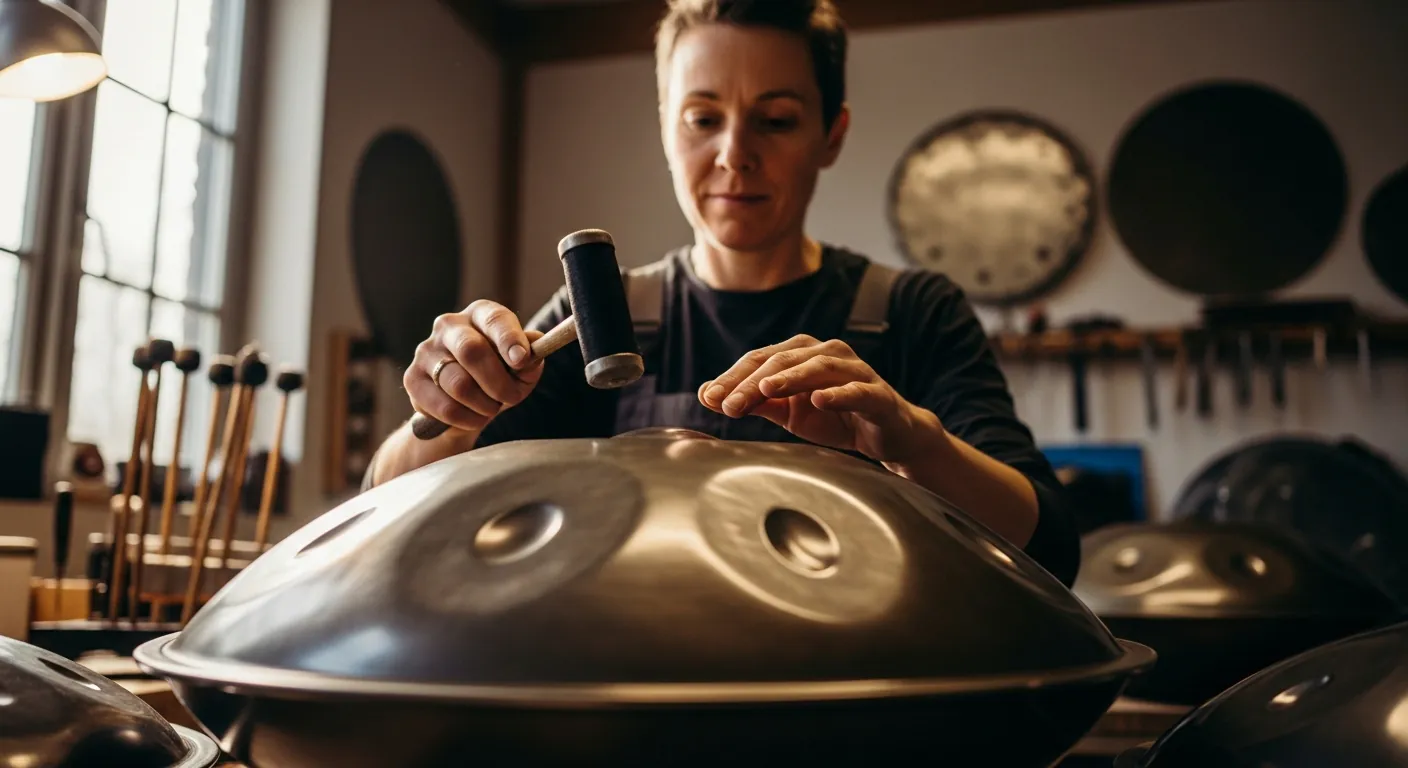
Handpan quality can be heard already in the first seconds of the game. Two instruments Made from similar materials, they can sound completely different—one will be bright, expressive, and more metallic, while the other will be warm, soft, and deep. A handpan's character is determined primarily by the material, the method of hand-shaping the sound fields, the precision of the tuning, and the experience of the makers. Let's break these elements down one by one—how I personally evaluate the instrument before it ships.
1. Material - two types of steel, two sound characteristics
My offer includes two series of handpans that differ in the material used, the extent of handwork and the character of the sound.
Professional Series handpans are crafted primarily from stainless steel. Their sound is bright, clear, and more expressive, with a more pronounced metallic character. Instruments in this series respond well to dynamic playing, with individual notes remaining distinct and clearly separated.
In the Mystical Series it is used Premium stainless steel. In my offerings, I use this term to describe material with a warmer, softer, and deeper sound. The sound is less metallic, more enveloping, and often perceived as meditative or velvety. The notes have a long sustain, creating a rich, spacious whole.
This doesn't mean that one type of steel is necessarily better than the other. The Professional Series may be more suitable for those seeking a bright, direct, and dynamic tone. The Mystic Series will suit those who prefer softness, warmth, depth, and long sustain.
However, the material is only the starting point. The final sound is also influenced by the way the sound fields are shaped, the precision of the tuning, the mutual balance of the notes, and the experience of the makers. Therefore, even two instruments made of the same type of steel can differ in their touch response, sustain, and overall sound character.
2. Manual shaping of sound fields - the heart of the instrument
One of the most important steps in creating a handpan is manually shaping the sound fields. Each field represents a specific note, but its preparation involves more than simply achieving the appropriate frequency indicated by the meter.
Maker works on the geometry of the field, the distribution of stresses in the material, the response to touch, and the way a given note interacts with the rest of the instrument. Even a small change in the shape of one field can affect the resonance of the entire bowl.
In the Professional Series, each sound field is hand-shaped and then hand-tuned by an experienced maker. This gives the instrument a unique character, good dynamics, and even response between individual notes.
In the Mystic Series, the amount of handwork is even greater. Maker also hand-crafts the central recesses in the sound fields, then hand-shapes the entire fields and precisely tunes them.
The sound field, also called the tonefield, is not a hole. It is a shaped area of the handpan surface responsible for a specific note. The central depression within it is called a dimple.
3. What is the difference between the Professional Series and the Mystical Series?
Both series are hand-shaped and tuned by specialized makers. However, they differ in materials, craftsmanship, and intended sound character.
In the Professional Series, the maker hand-sculpts each sound field and tunes the instrument by hand. This series offers a bright, clear, and more expressive sound, with a more pronounced metallic character.
In the Mystic Series, the maker hand-crafts the central recesses of the sound fields, hand-shapes the entire fields, and hand-tunes each note. Crafted from premium stainless steel, the series boasts a warmer, softer, deeper, and longer-lasting sound.
The Professional Series is designed as a robust and more affordable choice for those seeking a quality, stable, and hand-tuned instrument. The Mystic Series is designed for those who demand a more extensive craftsmanship process and a particular emphasis on depth of tone, sustain, and richness of sound.
The differences between the series are worth considering when you are wondering, which handpan to choose, to suit your play style and serve you for a long time.
4. Tuning and Harmony of Overtones
Every sound field produces a fundamental frequency and harmonic components that influence the depth, timbre, and character of the sound. This is where one of the most important differences between a merely decent instrument and a truly great one lies.
Precise tuning, It doesn't end with hitting the right frequency. The maker must also ensure that the harmonic components are in proper relationship to each other, and that the individual sound fields work together as a unified whole.
Good handpan It should sound coherent. The notes shouldn't seem like randomly collected sounds. They should be of similar quality, respond evenly to touch, and create a harmonious soundscape.
Sustain, or the length of a note's decay, is also important. A long sustain can add spaciousness and depth to the instrument, but it shouldn't compromise the clarity of the melody. A good instrument maintains a balance between sustain, tonal purity, and resonance control.
5. Experience and intuition of makers
Experienced makers don't rely solely on gauges. They also utilize their ear, their feel for the material, and the knowledge they gain from working on various instruments.
A good handpan isn't just the result of mathematical frequency tuning. It also involves hundreds of small decisions made while manually shaping and tuning the fields. The maker evaluates how the material responds to his input, how each note behaves, and how changes in one place affect the entire instrument.
A separate, specialized team of makers is responsible for each of the two series. One team produces the Professional Series, while the other is responsible for the Mystical Series and more demanding projects.
My role begins even before the instrument is made. I help select the scale, number of notes, reference frequency, and tonal character, and then delegate the implementation to the team responsible for the selected series.
Upon receiving a finished handpan, I personally inspect each piece. I assess its tuning, tonal character, sound field response, note balance, and overall build quality before preparing the instrument for shipping.
6. How to recognize a high-quality handpan? Test before purchasing
The easiest way to assess the quality of a handpan is by ear. Strike each note individually and listen for a clear, stable, and even tone. All notes should have a consistent character and similar response quality.
Play the same note softly, then a little harder. A good sound field should respond to different playing dynamics without metallic distortion, unpleasant vibrations, or sudden pitch breaks.
Also check the ding, or central sound field. It should sound clear, resonant, and in harmony with the other notes.
Note whether other notes are being excited randomly or uncontrollably when playing one course. A certain amount of collective resonance is natural and part of the character of the handpan. Problems arise when one note causes unpleasant thumping, fluttering, or loss of melody clarity.
It is also worth checking that the entire instrument remains stably tuned to the chosen reference frequency – 432 or 440 Hz.
Buying remotely? With me, you receive a recording of a specific instrument for approval before shipping. So you hear the exact instrument you'll eventually receive.
7. How to create the perfect handpan?
The ideal in music is subjective. One person seeks a warm, enveloping, and long-lasting sound. Another prefers a bright, spacious, expressive, or more percussive sound.
There is no single scale, material, or configuration that works for everyone. However, the common denominators of a good instrument are the right material, hand-shaping of sound fields, precise tuning, and the experience of the makers.
So instead of searching for the perfect handpan, I help you choose the perfect instrument for your specific needs. Tell me how you want to play and what kind of sound you're looking for— I will help you choose the scale, number of notes and tuning.
For inspiration, check out sample implementations, and if you are just getting to know the available sounds, read on guide to scales.
Want to discover instruments with a warmer, softer, and deeper character? Check out Mystical Series, in which we place particular emphasis on a greater range of manual work, long sustain and richness of sound.
If you're looking for a brighter, more expressive, and more affordable instrument with hand-shaped and tuned sound fields, check out Professional Series.
Before making a decision, also check:, what determines the price of a handpan.
FAQ - Questions about handpan quality
Depending on the type and preparation of steel, the precision of hand-shaping the sound fields, the precision of tuning the harmonic components, and the experience of the makers, even instruments made from similar materials can have completely different sonic characteristics.
Strike each note individually and assess the purity of the tone, sustain, response to light and firm touches, and tuning stability. Pay attention to the ding and whether all the notes sound consistent. When purchasing remotely, I will provide you with a recording of the actual instrument for your approval before shipping.
In both series, the sound fields are hand-shaped and tuned. The Professional Series is crafted primarily from stainless steel, which has a brighter and more expressive character. The Mystic Series uses premium stainless steel, which has a warmer and softer tone, and the maker also hand-crafts the central recesses of the sound fields.
Not necessarily. Price depends on, among other things, the number of notes, the complexity of the configuration, the material used, the extent of handiwork, and the selected series. Ultimately, the most important factors are the sound of a specific instrument, its stability, and its suitability to the player.

I run the Miłość i Spokój brand and personally test every instrument before shipping—playing it, checking its tuning, and listening. I work with handpan as a musician, a sound healing practitioner, and someone who simply can't stop playing.